Sunday, April 23, 2017

Week 8

The Devil and Tom Walker

          "The Devil and Tom Walker" is a short story by Washington Irving that first appeared in his 1824 collection Tales of a Traveller, as part of the "Money-Diggers" section. The story is very similar to the German legend of Faust. Stephen Vincent Benét drew much of his inspiration for "The Devil and Daniel Webster " from this tale.

Summary

            The story starts with the legend of William Kidd the pirate. It is rumored that Kidd had buried a large treasure in a forest in colonial Massachusetts. Kidd made a deal with the devil to protect his money. The devil's conditions are unknown. Kidd died never able to reclaim his money, but the devil has protected it ever since.
            The story continues around 1727. Tom Walker, a greedy, selfish miser of a man, cherishes money along with his shrewish and equally greedy wife. They lived in a tarnished looking house, that had stood alone and had an air of starvation. This is until he takes a walk in the swamp at an old Indian fortress (a relic of King Philip's War of 1675/1678), and starts up a conversation with the Devil incarnate (referred to as "Old Scratch" and "The Black Man" in the story). Old Scratch appears as a lumberjack or a woodsman chopping trees, each with a prominent and wealthy colonialist's name branded on the trunk. One rotted and soon-to-fall tree has the name of a deacon who grew wealthy "trading" with the Indians. Another fallen trunk has that of a wealthy seaman rumored to be a pirate. Old Scratch strikes a deal with Tom Walker, offering the riches hidden in the swamp by Captain Kidd in exchange for a great price, which is often thought to be his soul. Tom agrees to think about it and returns home.
            Burdened with this secret, he tells his wife. While he has no scruples in selling himself to Old Scratch for the treasure, he does not wish to do so for his wife's sake. She meets Old Scratch herself but tells her husband Old Scratch requires an offering. When Tom is away, she takes all their valuables in and goes to make a deal with Old Scratch. When Tom searches for his wife and property, all he finds is her apron holding her heart and liver, tied to a tree.
           Tom Walker agrees to Old Scratch's deal, as he considered his abusive wife's death a good thing. Because he can only use the treasure in Old Scratch's service, Tom agrees to become a usurer (today commonly called a loan shark), although Tom has scruples about becoming a slave trader.
            During the governorship of Jonathan Belcher (1730-1741), speculation runs rampant, and Walker's business flourishes. Becoming a member of the local stock exchange, Tom buys a big house and a coach but furnishes neither even though he has the money (he is so miserly he even half starves his horses). Tom never tires of swindling people until he suddenly becomes fearful about the afterlife. He then becomes fiercely and loudly dedicated to God, always keeping two Bibles at hand—thinking that any sin on his neighbors "account" is a "credit" to his own. He even has his best riding horse saddled and buried upside down so that he might flee when Old Scratch comes to collect his due from Tom.
           One day a ruined stock jobber (speculator) who had borrowed money from him asks for clemency and annoys Tom who says, "The Devil take me if I have made but a farthing!" (the smallest currency of the time, 1/4 of a penny). There are three loud knocks at the door. Tom is drawn towards a black-cloaked figure and realizes, in horror, that he has left his Bibles at his desk.
          Old Scratch tosses Tom Walker on the back of a black horse which rides toward the old fortress and disappears in lightning. Tom is never seen again. All his assets become worthless—his coach horses become skeletons, the gold and silver Tom hoarded turn into wood chips and shavings, his mortgages and deeds become cinders, and his great house burns to the ground. Since that day, his ghost haunts the site of the old fortress. His only legacy is a New England saying, "The Devil and Tom Walker".

Saturday, April 15, 2017

Week 7

The Lady in Black (By Eleanor H. Porter)

              The house was very still.  In the little room over the porch, the Lady in Black sat alone. 
Near her, a child's white dress lay across a chair.  On the floor at her feet lay a tiny pair of shoes. 
A doll hung over a chair and a toy soldier occupied the little stand by the bed. And everywhere was silence—the strange silence that comes only to a room where the clock has stopped ticking. The clock stood on the shelf near the end of the bed.  The Lady in Black looked at it.  She remembered the wave of anger that had come over her when she had reached out her hand and silenced the clock that night three months before. It had been silent ever since and it should remain silent, too.  Of what possible use were the hours it would tick away now?  As if anything mattered, with little Kathleen lying out there white and still under the black earth! The Lady in Black looked at them with serious eyes, and her mouth hardened at the corners. Bobby had someone to play with him, someone to love him and care for him, while out there on the hillside Kathleen was alone--all alone. With a little cry the Lady in Black sprang to her feet and hurried into her own room. Her hands shook as she pinned on her hat and covered herself with her black veil.  But her step was firm as she walked downstairs and out through the hall.
               The house was very still when the Lady in Black reached home.  She shivered at its silence.  She hurried up the stairs, almost with guilt.  In her own room she pulled at the dark veil that covered her face.  She was crying now, a choking little cry with broken words running through it.  She was still crying as she removed her black dress.
                Long minutes later, the Lady--in black no longer--moved slowly down the stairway.  Her eyes showed traces of tears, but her lips were bravely curved in a smile.  She wore a white dress and a single white rose in her hair.  Behind her, in the little room over the porch, a tiny clock ticked loudly on its shelf near the end of the bed.
There came a sound of running feet in the hall below, then:
"Muvver!--it's Muvver come back!" shouted a happy voice.
And with a little sobbing cry Bobby's mother opened her arms to her son.
"The Lady in Black" was written by Eleanor H. Porter.  It was adapted for Special English by Lawan Davis who was also the producer.  The storyteller was Faith Lapidus.

Week 6

The Return of a Private by Hamlin Garland

               Our story today is called, "The Return of a Private. " It was written by Hamlin Garland. Here is Harry Monroe with our story. The soldiers cheered as the train crossed the border into the state of Wisconsin. It had been a long trip from the south back to their homes in the north. One of the men had a large red scar across his forehead. Another had an injured leg that made it painful for him to walk. The third had unnaturally large and bright eyes, because he had been sick with malaria. The three soldiers spread their blankets on the train seats and tried to sleep. It was a cold evening even though it was summertime. Private Smith, the soldier with the fever, shivered in the night air. His joy in coming home was mixed with fear and worry. He knew he was sick and weak. How could he take care of his family? Where would he find the strength to do the heavy work all farmers have to do? He had given three years of his life to his country. And now he had very little money and strength left for his family. Morning came slowly with a pale yellow light. The train was slowing down as it came into the town of La Crosse where the three soldiers would get off the train. The station was empty because it was Sunday. "I'll get home in time for dinner," Smith thought. "She usually has dinner about one o'clock on Sunday afternoon,” and he smiled. Smith and the other two soldiers jumped off the train together. "Well, boys," Smith began, "here's where we say good-bye. We've marched together for many miles. Now, I suppose, we are done." The three men found it hard to look at each other.                  Mary Gray was a widow with a large family of strong sons and pretty daughters. She was poor. But she never said 'no' to a hungry person who came to her farm and asked for food. She worked hard, laughed often and was always in a cheerful mood. The long table in the kitchen was piled with food. There were potatoes, fresh corn, apple pies, hot bread, sweet pickles, bread and butter and honey. They all ate until they could eat no more. Then the men and children left the table. The women stayed to drink their tea. When she got back to their farm, she saw the man standing by the fence. He was looking at the little house and the field of yellow wheat. The sun was almost touching the hills in the west. The cowbells rang softly as the animals moved toward the barn.
                His farm needed work. His children needed clothing. He was no longer young and strong. But he began to plan for next year. With the same courage he had faced the war, Private Smith faced his difficult future. You have just heard the story, "The Return of a Private." It was written by Hamlin Garland, and adapted for Special English by Dona de Sanctis. Your narrator was Harry Monroe.

Words in This Story

scar - n. a mark that is left on your skin after a wound heals
forehead - n. the part of the face above the eyes
malaria - n. a serious disease that causes chills and fever and that is passed from one person to another by the bite of mosquitoes
mood - n. the way someone feels : a person's emotional state
pickle - nchiefly US: a cucumber that is preserved in salt water or vinegar barn - n. a building on a farm that is used for storing grain and hay and for housing farm animals or equipment
courage - n. the ability to do something that you know is difficult or dangerous

Saturday, April 1, 2017

Week 5

The Luck of Roaring Camp

                 "The Luck of Roaring Camp" is a short story by American author Bret Harte. It was first published in the August 1868 issue of the Overland Monthly and helped push Harte to international prominence.
The story is about the birth of a baby boy in a 19th-century gold prospecting camp. The boy's mother, Cherokee Sal, dies in childbirth, so the men of Roaring Camp must raise it themselves. Believing the child to be a good luck charm, the miners christen the boy Thomas Luck. Afterwards, they decide to refine their behavior and refrain from gambling and fighting. At the end of the story, however, Luck and a villager, Kentuck, perish in a flash flood that strikes the camp.
                   Roaring Camp was a real place. It was a goldmining settlement on the Mokelumne River in Amador County, California. It was home to forty-niners seeking gold in and around the river; it is now a privately owned tourist attraction. The story's flood theme may have been inspired by California's Great Flood of 1862, which Harte witnessed.

Plot summary

                   The story takes place in a small struggling mining town located in the foothills of the California mountains at the time of the gold rush. The camp is suffering from a long string of bad luck. With only one woman in their midst, it seems as though the miners have no future. However, the tide turns when a small boy is born. "Thomas Luck" is the first newborn the camp has seen in ages; things are looking up. The miners become cheerful, foliage begins to grow, and there is talk of building a hotel to attract outsiders. Unfortunately, the hope is wiped out by the sudden death of Luck in a flood. Water brought gold to the gulches, giving miners their first glimmer of hope. And water takes away what seems their last glimmer—Luck. And the strong man, still holding the small child, drifted away on the shadowy river that flows forever to the unknown sea.
                   You have just heard "The Luck of Roaring Camp," a story by Bret Harte.  It was adapted for Special English by Dona De Sanctis.  Your storyteller was Harry Monroe.

Characters

Thomas Luck
Newborn child thought to be the savior of the camp
Kentuck
A rugged prospector who tries to save Thomas Luck's life in the flood
Cherokee Sal
Mother of Thomas Luck; only woman in camp
Stumpy
Guardian of Thomas Luck
Oakhurst
A gambler who gives Thomas Luck his name. (This may be the same character as the John Oakhurst of Harte's short story "The Outcasts of Poker Flat".)
https://upload.wikimedia.org/wikipedia/commons/5/54/Luck_of_Roaring_Camp.jpg

Saturday, March 25, 2017

Week4

        "Pigs Is Pigs" is a story written by Ellis Parker Butler. First published as a short story in American Illustrated Magazine in September 1905, "Pigs Is Pigs" went on to dozens of printings as a book and in anthologies over the next several decades.

Plot

          Railway agent Mike Flannery wants to charge the livestock rate for a shipment of two guinea pigs and refuses to accept the lower pet rate, saying "pigs is pigs". Flannery believes that the "guinea" is an indication of the pigs' national origin. He argues that they should bear the higher freight charge of 30¢ for livestock, rather than the lower 25¢ for domestic pets. In support of this, he submits that if they were "dago pigs" or "paddy pigs", there would be no question of the animals' status.
Because the customer refuses to accept delivery, Flannery is forced to feed and house what he now calls the "dago pigs" in his office, until he receives permission from his superiors to return the pigs to the company warehouse. By this time, the guinea pigs have reproduced exponentially in Flannery's station house. After returning all the descendants, Flannery resolves to charge the lower rate for any future livestock.
          At last, he got an urgent telegram from the main office:  "Send the pigs to the main office of the company at Franklin."  Flannery did so.  Soon, came another telegram.  "Stop sending pigs.  Warehouse full."  But he kept sending them.
       "Pigs is Pigs" was written by Ellis Parker Butler.  It was adapted for Special English by Harold Berman.  The storyteller was Shep O'Neal.  The producer was Lawan Davis.I'm Shirley Griffith.  

Pigs is Pigs cover when published in 1905 by Railway Appliances Company (Chicago) without permission, most copies were destroyed.

Friday, March 17, 2017

Week3

An Occurrence at Owl Creek Bridge

           "An Occurrence at Owl Creek Bridge" or "A Dead Man's Dream" is a short story by American author Ambrose Bierce. Originally published by The San Francisco Examiner on July 13, 1890, it was first collected in Bierce's 1891 book Tales of Soldiers and Civilians. The story, which is set during the Civil War, is famous for its irregular time sequence and twist ending. Bierce's abandonment of strict linear narration in favor of the internal mind of the protagonist is considered an early example of experimentation with stream of consciousness. It is Bierce's most anthologized story.

Plot summary

             Peyton Farquhar, a plantation owner in his mid-thirties, is being prepared for execution by hanging from an Alabama railroad bridge during the American Civil War. Six military men and a company of infantrymen are present, guarding the bridge and carrying out the sentence. Farquhar thinks of his wife and children and is then distracted by a noise that, to him, sounds like an unbearably loud clanging; it is actually the ticking of his watch. He considers the possibility of jumping off the bridge and swimming to safety if he can free his tied hands, but the soldiers drop him from the bridge before he can act on the idea.
              In a flashback, Farquhar and his wife are relaxing at home one evening when a soldier rides up to the gate. Farquhar, a supporter of the Confederacy, learns from him that Union troops have seized the Owl Creek railroad bridge and repaired it. The soldier suggests that Farquhar might be able to burn the bridge down if he can slip past its guards. He then leaves, but doubles back after nightfall to return north the way he came. The soldier is actually a disguised Union scout who has lured Farquhar into a trap, as any civilian caught interfering with the railroads will be hanged.
              The story returns to the present, and the rope around Farquhar's neck breaks when he falls from the bridge into the creek. He frees his hands, pulls the noose away, and surfaces to begin his escape. His senses now greatly sharpened, he dives and swims downstream to avoid rifle and cannon fire. Once he is out of range, he leaves the creek to begin the journey to his home, 30 miles away. Farquhar walks all day long through a seemingly endless forest, and that night he begins to hallucinate, seeing strange constellations and hearing whispered voices in an unknown language. He travels on, urged by the thought of his wife and children despite the pains caused by his ordeal. The next morning, after having apparently fallen asleep while walking, he finds himself at the gate to his plantation. He rushes to embrace his wife, but before he can do so, he feels a heavy blow upon the back of his neck; there is a loud noise and a flash of white, and everything goes black.
               It is revealed that Farquhar never escaped at all; he imagined the entire third part of the story during the time between falling through the bridge and the noose breaking his neck.

Tuesday, March 14, 2017

Week2

The Boarded Window
                  "The Boarded Window: An Incident in the Life of an Ohio Pioneer" is a short story by Ambrose Bierce. It was first published in The San Francisco Examiner on April 12, 1891 and was reprinted the same year in Bierce's collection Tales of Soldiers and Civilians. The setting for the story is that part of Ohio where Bierce's family lived until 1846.

Plot summary


          The story tells of a man named Murlock who lived alone in his cabin and was found dead one day. He was buried near the cabin next to his wife. The narrator tells the reader that this is all the known facts of the story, but there are some whispers about what had happened.
In 1820, Murlock had returned from hunting to find his wife in dire fits that eventually caused her to die. There was no means of saving her and thus, he found himself alone with her dead body. Later on, with her dead in the room, he fell asleep. At that moment came in through the open window a long, wailing sound like the cry of a lost child in the far deeps of the darkening wood! But the man did not move. Again, and nearer than before, sounded that unearthly cry upon his failing sense. Perhaps it was a wild beast; perhaps it was a dream. For Murlock was asleep.
When he awoke there was some other presence in the room and he could feel it. The table shakes and there is movement but in the dark it is hard to discern. He fires his rifle to see what is going on and witnesses a panther dragging his wife by the neck. Upon examining the wife's corpse, Murlock sees that there is part of the panther's ear in between her teeth.   The clothing was ruined. The long hair was in disorder. The arms and legs lay in a careless way. And a pool of blood flowed from the horribly torn throat. The ribbon he had used to tie the wrists was broken. The hands were tightly closed.
And between the teeth was a piece of the animal's ear.
        "The Boarded Window" was written by Ambrose Bierce. It was adapted for Special English by Lawan Davis who was also the producer. The storyteller was Shep O'Neal.

Friday, March 3, 2017

The Gift Of Magi

This store is about a young couple, Della and Jim.
Della the wife were looking for a Christmas' gift for her husband, Jim, but she didn't have enough money to buy the gift that she wanted to give her husband, something fine and rare. Then she found a way to earn money, That was sold her beautiful long brown hair. her hair was so beautiful so she could afford something nice for her husband after she sold it. With out hesitated, she sold her hair and held the money looked around all stores to fine the gift and finally, she found a silver chain for her husband, which is perfectly suitable for his gold watch.
Then Della went back to home, Waited for her husband. After Jim went into the house, he was shocked about what he saw, his wife's beautiful hair was gone! And he had bought beautiful combs for his wife. Della also been frightened by those gifts, but soon she calmed down and comforted her husband. She took out her gift for Jim but he dramatic thing is, her husband sold his gold watch for bought her the gifts!
The reason why "The Gift Of Magi" is the title of this story is, the author want to use the name of Magi ---- a wise man---- to tell people be wise when they are doing something. But I think this story is actually a warm story. Even though our young couple lost their important things, they still found out the people who can give up something important for them. I can imagine how happy they would be after the Christmas. Therefor, I'm quiet like this story after all.

Thursday, March 2, 2017

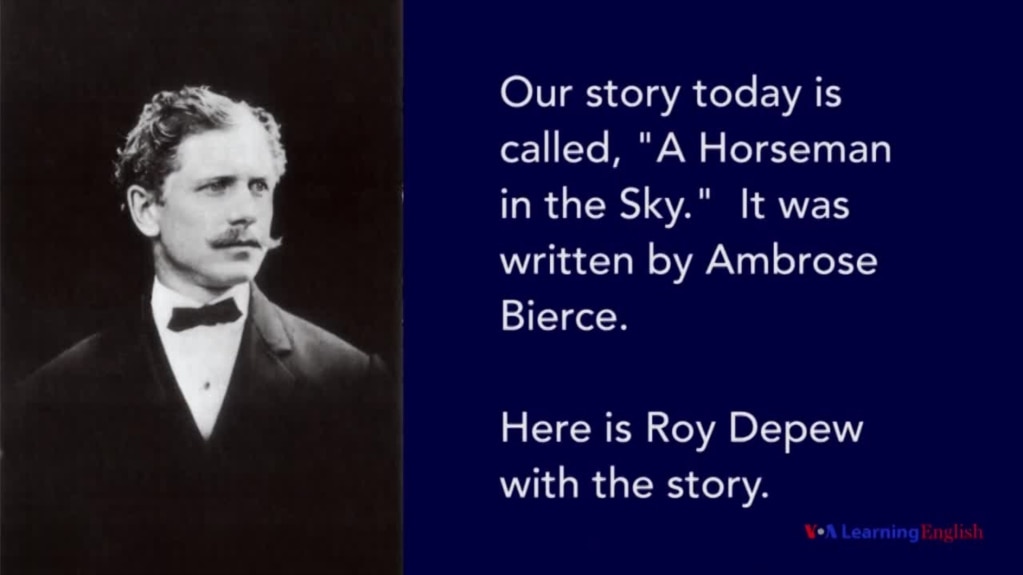
A Horseman in the Sky

            "A Horseman in the Sky" is a heavily anthologized short story by Ambrose Bierce. It was published on April 14, 1889 under the title The Horseman in the Sky in the Sunday edition of The Examiner, a San Francisco periodical owned by William Randolph Hearst.[1] It is set during the American Civil War and is one of Bierce's best known war stories. Bierce had the story revised for an 1892 edition of his works.

Plot summary

             A soldier lies on the ground on the lookout for the terrain and any potential enemy soldiers that might arrive. He falls asleep but luckily is not discovered by his sergeant as it would mean his death. When he awakes, he sees a man standing on a ledge on a horse who is of the Confederacy. He contemplates to shoot the man but finds himself morally challenged. In the end, he shoots the horse. Both the man and his horse leap off the ledge.
             An officer who happens to be in the forest under the ledge looks up and sees a man on a horse, seemingly running through the sky. It shocks him and he all but passes out. When he recovers he goes searching for the man but does not find man or horse. When he returns to camp, he says nothing. Meanwhile, a superior comes up to the soldier to ask what he's seen and the soldier tells him that he shot at a horse in order to kill the man. When asked to identify the man, he explains the man was his father and a Confederate soldier.
             Perhaps he was only admiring the view. Perhaps he would now turn and ride carelessly away.
Then Carter looked down into the valley so far below. He saw a line of men in blue uniforms and their horses, slowly leaving the protection of the forest. A foolish Union officer had permitted his soldiers to bring their horses to drink at a small stream near the forest. And there they were -- in plain sight!
Carter Druse looked back to the man and horse standing there against the sky. Again he took aim. But this time he pointed his gun at the horse. Words rang in his head -- the last words his father ever spoke to him: "No matter what happens, be sure you always do what you think is your duty."
Image result for a horseman in the sky summary

Summary of The Devil and Tom Walker by Washington Irving.


A long time ago the most famous men in the world was Captain William Kidd. He was a pirate and he sailed the seas, capturing any ships he found. He stole a lot of money from these ships and became a very rich man. Before being executed in 1701, Captain Kidd hid his treasure in several places and people all over the world searched in many places for his stolen money. Some people believe that a part of his treasure is near Boston and is protected by the devil himself, who was a good friend of Captain Kidd. In 1727, a man named Tom Walker lived near this place.Tom and his wife were very bad people. The only thing they loved in this word was money. Someday, Tom was returning home through a dark forest when he sat down on a tree that had fallen when he found a human skull and someone shouted: "Don't touch that skull!". So, Tom saw a giant sitting on a broken tree. He wore the clothes of an Indian. His skin was almost black and covered with ashes. His eyes were big and red. His black hair stood up from his head. He carried a large ax. After a short conversation, Tom realized that the great giant was the Devil himself. The giant said Captain Kidd had buried great treasures under the trees, but nobody could have them unless the giant permitted it, but Tom could have these treasures if he agreed to give the giant what he demanded. What Happens from there? You have to figure out for yourself. Would you do anything for money? Would you be able to sell your soul to the Devil?. Find out what Tom did and how this exciting story ends!  

summarizing of "The Story of an Eyewitness"


It is real story in April 18th, 1906. Alll of the disappeared by thirty seconds of movement by the earth. San Francisco suffered a huge earthquake. Everything is gone: San Francisco, industrial area, business area, social and living areas, factories, etc. The earthquake began a huge fire. And the fire had broken everything once again. The heated air made a huge wind that pulled air into the fire, rising into the atmosphere and the wind was often as strong as a storm. Few day later, yet there was a change. A rain of ashes was falling. The human nothing could be done. Nothing could be saved. The surrender was complete. This part of the city was already a waste of smoking ruins. In the end, the fire went out by itself because there was nothing left to burn.
After everything was done, everyone started moving for people in San Francisco and again build a beautiful city.

Wednesday, March 1, 2017

A Princess of Mars , Part 1


                   The character name is John Carter . He is from the state of Virginia . He is an old man and he is always thinking a man about thirty . he is wondering about his age and ask himself about who have died two times and he still alive . He found himself  homeless , without money and without work . He decided a plan to search for gold in the deserts of the American Southwest . He spent a whole year searching for gold with another former soldier, Captain James Powell, and he is also of Virginia . They were lucky because they found rocks that held gold .  James Powell said they had uncovered more then million dollars worth of gold in few months.  But the work was so difficult  with two men and some tools . Then they decided Powell must go to the nearest settlement to meet equipment and men to help them with the work . Then, Powell rode his horse down the mountain and John followed his progress for several hours. He was surprised to see three riders in the same place where he had last seen his friend . in a moment , he heard shots far ahead of him . He came to a small camp. A hundred Apache Indians were the camp and began shooting . He forced his horse into the camp and he reached down and pulled him up on the horse by his belt until he came to the mouth of a large cave and  Powell was dead . He found a safe place in the cave to sleep, But one of the Indians came and looked to him and John couldn't move because he was afraid and do nothing, Then he felt sleep . Next day he found himself  lying on a bed of yellow colored grass in Mars . He found that he must learn to walk again . Near him was a small wall and he made his way to the wall and looked over the wall . It was eggs, some green creatures were in them . They looked at me with red eyes, And they had come without warning . He saw them and One was coming to him with a huge spear, with a knife  pointed at his heart!

Monday, February 27, 2017

Dear Extensive Readers,

I have found a wonderful site that we will be using as an extra support for our class that I hope will be beneficial in learning new vocabulary and also to practice important skills such as listening and comprehension. For your first assignment I want you to choose an American Story to read and listen and then to write a summary to check for comprehension. Just like in this class the focus is reading to help with vocabulary and comprehension. This will also help in listening skills. I suggest writing new vocabulary words in your journal as always.

The website is www.manythings.org

You will read the story while listening to it and then write your summary in our classroom blog. You can write your summary in the form of a short review of the reading.

Happy reading!!!